
Monday, August 6, 2012
Color Me C-FB

Milestones: Your Baby at Six Months
 How your child plays, learns, speaks, and acts offers important
clues about your child’s development. Developmental milestones are
things most children can do by a certain age.
How your child plays, learns, speaks, and acts offers important
clues about your child’s development. Developmental milestones are
things most children can do by a certain age.Check the milestones your child has reached by the end of 6 months. Take this with you and talk with your child’s doctor at every visit about the milestones your child has reached and what to expect next.
What most babies do at this age:
Social and Emotional
- Knows familiar faces and begins to know if someone is a stranger
- Likes to play with others, especially parents
- Responds to other people’s emotions and often seems happy
- Likes to look at self in a mirror
Language/Communication
- Responds to sounds by making sounds
- Strings vowels together when babbling (“ah,” “eh,” “oh”) and likes taking turns with parent while making sounds
- Responds to own name
- Makes sounds to show joy and displeasure
- Begins to say consonant sounds (jabbering with “m,” “b”)
Cognitive (learning, thinking, problem-solving)
- Looks around at things nearby
- Brings things to mouth
- Shows curiosity about things and tries to get things that are out of reach
- Begins to pass things from one hand to the other
Movement/Physical Development
- Rolls over in both directions (front to back, back to front)
- Begins to sit without support
- When standing, supports weight on legs and might bounce
- Rocks back and forth, sometimes crawling backward before moving forward
Are Fat Babies Smarter?
 Source: www.brainy-child.com
Baby brain development is affected greatly by a baby's nutrition intake. Children who are malnourished will resulted an inadequate brain growth that showing lower IQ, slower language and fine motor development. Before we talk about the kind of food that we need to 'feed' the brain. We probably want to ask ourselves, what is our brain made of?
Our brain is primarily fat, 60% by dry weight! Few people realize how important fat is to a healthy brain. And DHA, the most plentiful fatty acid in the brain, is crucial to brain health, from infancy to old age.
Click here to find out more about DHA and nutrition for the brain.
Thursday, July 26, 2012
Easing the First Day Jitters
 Here are a few excellent books to read to your children to ease their worries about starting school.
The Night Before Kindergarten by Natasha Wing
First Day Jitters by Julie Danneberg
Countdown to Kindergarten by Alison McGhee
The Kissing Hand by Audrey Penn
Wednesday, July 25, 2012
Milestones: Your Baby at Four Months
 How your child plays, learns, speaks, and acts offers
important clues about your child’s development. Developmental
milestones are things most children can do by a certain age.
How your child plays, learns, speaks, and acts offers
important clues about your child’s development. Developmental
milestones are things most children can do by a certain age.
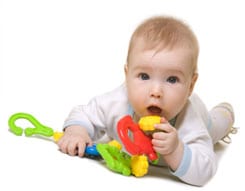
What most babies do at this age:
Social and Emotional
- Smiles spontaneously, especially at people
- Likes to play with people and might cry when playing stops
- Copies some movements and facial expressions, like smiling or frowning
Language/Communication
- Begins to babble
- Babbles with expression and copies sounds he hears
- Cries in different ways to show hunger, pain, or being tired
Cognitive (learning, thinking, problem-solving)
- Lets you know if she is happy or sad
- Responds to affection
- Reaches for toy with one hand
- Uses hands and eyes together, such as seeing a toy and reaching for it
- Follows moving things with eyes from side to side
- Watches faces closely
- Recognizes familiar people and things at a distance
Movement/Physical Development
- Holds head steady, unsupported
- Pushes down on legs when feet are on a hard surface
- May be able to roll over from tummy to back
- Can hold a toy and shake it and swing at dangling toys
- Brings hands to mouth
- When lying on stomach, pushes up to elbows
Tuesday, July 24, 2012
Take a Bite out of Math
Having fun with food is a great way to introduce your child to math.
Here is a simple idea to get you started.
Marshmallow Ant

Together with your child, count out the "body parts" and sort them into different groups. Count them aloud as you go. You can discuss the different shapes as your sort. Make each component of the ant a math problem. Example: Three legs plus three legs equals six legs all together. You get the idea!
Here is a simple idea to get you started.
Marshmallow Ant

Together with your child, count out the "body parts" and sort them into different groups. Count them aloud as you go. You can discuss the different shapes as your sort. Make each component of the ant a math problem. Example: Three legs plus three legs equals six legs all together. You get the idea!
Here is what you need:
3 large marshmallows (body parts)Peanut Butter (ant glue)2 M&M's (eyes)11 pretzel sticks
(6 legs, 2 antennae, 2 to hold the body parts together, and 1 broke in half to form the mandible)
(6 legs, 2 antennae, 2 to hold the body parts together, and 1 broke in half to form the mandible)
Let your creativity guide you. Keep it simple, keep it healthy, make it fun!
Monday, July 23, 2012
Creative Way to Learn Colors
 Identifying colors is a necessary skill that people use everyday—for
choosing which clothes to wear, reading signs, following traffic
signals, and describing the surrounding world.
Identifying colors is a necessary skill that people use everyday—for
choosing which clothes to wear, reading signs, following traffic
signals, and describing the surrounding world.Introduce your child to this bright new world of colors using ordinary household objects such as buttons, beads, and marbles. She can group these objects into different sections and learn to recognize their written names using a homemade egg carton sorter.
This activity provides an interactive, colorful way for your preschooler to practice color recognition!
activity directions
Subscribe to:
Posts (Atom)